

Imagine spending weeks planning your dream vacation, carefully reading hundreds of hotel reviews, only to arrive and discover the reality looks nothing like what you were promised. The pool shown in glowing reviews? Under renovation. The “spotless rooms” praised by dozens of five-star ratings? Anything but. Unfortunately, this scenario plays out for travelers every single day — and fake hotel reviews are largely to blame. Studies suggest that up to 30–40% of online reviews across major platforms may be fake or manipulated, making it harder than ever to trust what you read before booking. The good news? With the right knowledge, you can learn to spot the warning signs before they cost you money, time, and your well-deserved break. In this guide, we’ll walk you through 7 key red flags that reveal fake hotel reviews — plus bonus tips on how to find reviews you can actually trust.
Why Fake Hotel Reviews Are Such a Big Problem
Before diving into the red flags, it helps to understand why fake reviews exist in the first place. The hotel industry is fiercely competitive, and online ratings can make or break a property’s revenue. A single star improvement in a hotel’s average rating on platforms like TripAdvisor or Booking.com can translate into a 5–9% increase in bookings, according to research from Cornell University. That kind of financial incentive creates powerful motivation to game the system.
Fake hotel reviews generally come from a few key sources:
- Hotels themselves — paying individuals or review farms to post glowing five-star ratings
- Competitors — posting negative reviews to damage a rival property’s reputation
- Review bots and content mills — automated systems that churn out bulk reviews at scale
Major platforms like TripAdvisor, Booking.com, Google, and Expedia all invest heavily in fraud detection — but none of them can catch everything. The arms race between fake review creators and platform algorithms is ongoing, which means travelers need to develop their own critical eye.
The 7 Red Flags of Fake Hotel Reviews
🚩 Red Flag #1: Overly Vague or Generic Language
One of the easiest ways to spot a fake hotel review is to notice what’s not there. Real travelers tend to mention specific details — the name of a helpful staff member, the view from their particular room, how the buffet breakfast compared to other hotels they’ve visited, or a small quirk that made their stay memorable. Fake reviews, by contrast, tend to rely on hollow phrases:
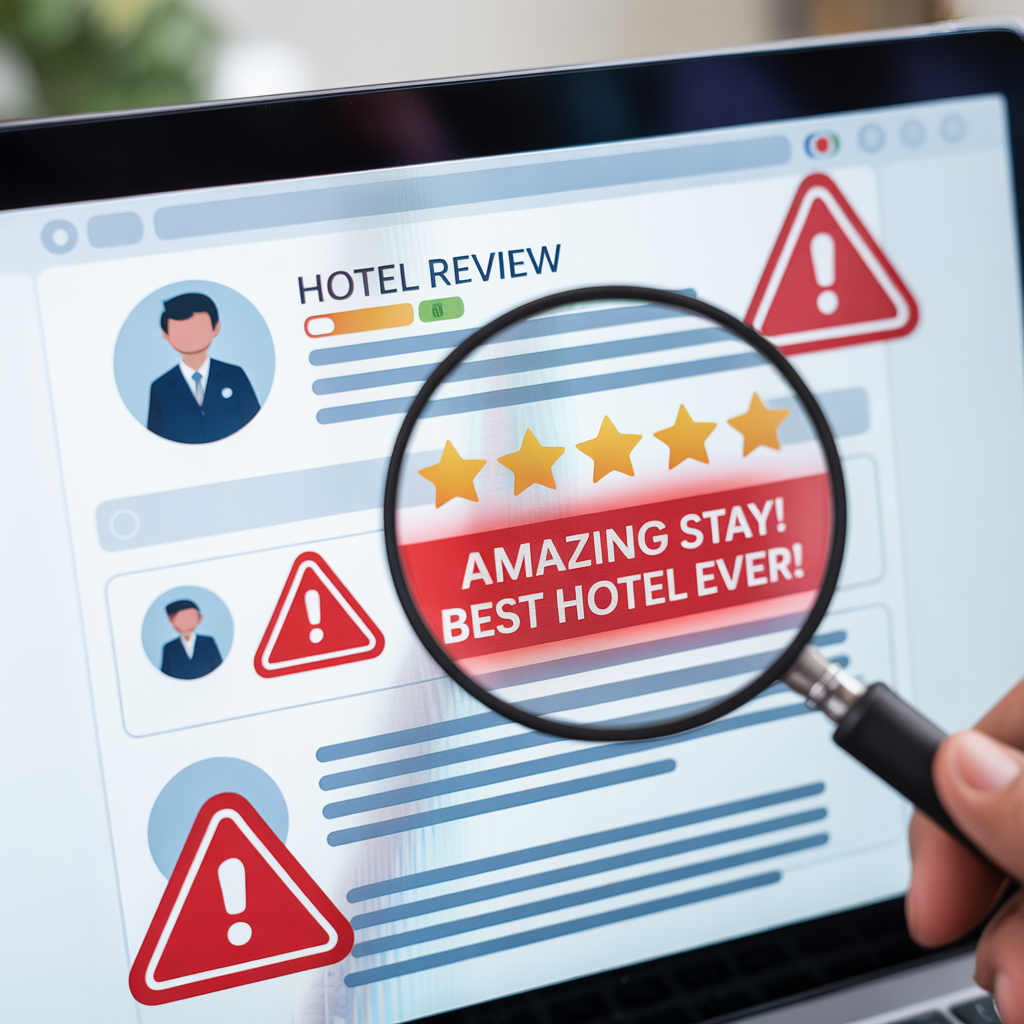
- “Amazing stay! Highly recommend!”
- “Great hotel, perfect location, will definitely return.”
- “Best experience ever. Loved everything about it!”
These reviews sound positive, but they contain zero useful information. There’s no room type mentioned, no reference to actual amenities, and no personal anecdote. When an entire batch of reviews reads like corporate marketing copy, that’s a serious red flag.
What to look for instead: Authentic reviews mention specific details — room numbers, meal descriptions, staff by name, or comparisons to other hotels. The more granular the details, the more likely the experience was real.
🚩 Red Flag #2: Extreme Ratings With No Middle Ground
Take a look at the rating distribution of any hotel you’re considering. A natural, healthy hotel profile will show a bell-curve-like spread — a strong cluster of 4-star reviews, a fair number of 3-star and 5-star ratings, with some 1-star and 2-star outliers. If a hotel shows only two extremes — hundreds of five-star ratings and a handful of one-star complaints with almost nothing in between — something doesn’t add up.
This pattern often indicates that positive reviews have been artificially inflated, or that negative reviews have been suppressed or reported for removal. Both scenarios are manipulative.
How to check: On Booking.com, you can filter reviews by score category. On TripAdvisor, click “Rating” in the filter options to see the full distribution. On Google, the star breakdown is displayed directly below the overall rating. Always check this breakdown — it tells a more complete story than the average score alone.
🚩 Red Flag #3: Suspicious Reviewer Profiles
Behind every review is a reviewer — and fake reviews often come from accounts that barely exist. When you’re evaluating hotel reviews, make a habit of clicking on the reviewer’s profile. Look for these warning signs:
- The account was created very recently (days or weeks ago)
- The reviewer has posted only one or two reviews — often for the same hotel or the same type of business
- There is no profile photo, no bio, and no review history across different destinations
- Multiple reviews were posted by different accounts but written in a strikingly similar style
Real travel enthusiasts accumulate reviews over time, across different cities, hotels, restaurants, and attractions. A brand-new profile with a glowing five-star review for a single hotel should raise your suspicion immediately.
Platform tip: TripAdvisor shows how long a member has been on the platform and how many reviews they’ve written. Google also displays review counts on local guide profiles. Use this information wisely.
🚩 Red Flag #4: Unnatural Language Patterns and Writing Style
Language is one of the most telling indicators of a fake review. Reviews written by bots or paid writers often display distinctive patterns that feel “off” to a careful reader:
- Robotic, overly formal phrasing that doesn’t match how a casual traveler speaks
- Repetitive phrases appearing across multiple reviews (e.g., “I was thoroughly impressed by the level of professionalism”)
- Excessive use of superlatives: “absolutely flawless,” “undeniably the best,” “perfectly impeccable”
- Awkward grammar patterns that suggest machine translation or non-native writing farms
The tell-tale sign? Real reviewers sound like people. They use casual language, include complaints alongside praise, and occasionally make grammatical errors in a natural, human way — not in the stilted, repetitive way that review bots produce.
Useful tools: Try running hotel reviews through Fakespot.com or ReviewMeta. These AI-powered tools analyze language patterns, reviewer behavior, and rating anomalies to give you an authenticity grade for any set of reviews. They’re free and surprisingly accurate.
🚩 Red Flag #5: Timing Clusters — Too Many Reviews Posted at Once
One of the clearest signs of bulk review purchasing is a sudden spike in reviews posted within a very short time window. Imagine a hotel that received 3–5 reviews per month for the past year, then suddenly accumulates 40 glowing five-star reviews in a single week. That’s not organic growth — that’s a purchase.
Hotels may buy reviews in bulk before peak travel seasons (think summer holidays or major events) to boost their ranking in search results. Others flood the platform with positive reviews right after a wave of negative ones, hoping to bury the bad feedback.
How to check: On most platforms, you can sort reviews chronologically — either “newest first” or “oldest first.” Scroll through the timeline and look for unusual spikes. A cluster of 20+ reviews posted within the same 48-hour window should immediately raise your suspicion, especially if they’re all five-star ratings with similarly vague language.
🚩 Red Flag #6: Reviews That Don’t Match the Photos or Reality
This red flag requires a bit of cross-referencing, but it’s one of the most revealing checks you can do. If multiple reviews rave about a rooftop pool, a state-of-the-art gym, or a lavish breakfast spread — but none of these features appear in the hotel’s official photos or on their website — something doesn’t add up.
Overly polished reviews that read like brochure copy (“The exquisitely appointed rooms exude an atmosphere of refined elegance”) are also suspicious. Real guests don’t talk like hotel marketing departments.
What to do: Before booking, cross-reference reviews with:
- The hotel’s official photo gallery
- Google Street View and Google Maps photos uploaded by visitors
- Instagram and TikTok tagged posts from real guests (search the hotel’s name or location tag)
- Travel forums like Reddit’s r/travel community, where users are more likely to share unfiltered opinions
🚩 Red Flag #7: Suspicious Response Patterns from Hotel Management
Don’t just read the guest reviews — pay close attention to how hotel management responds to them. A hotel’s reply behavior can be just as revealing as the reviews themselves. Watch out for:
- Copy-pasted responses: If a hotel’s management replies to every review with near-identical text, it suggests automated or insincere engagement.
- Ignoring all negative reviews: A hotel that responds warmly to five-star reviews but completely ignores one-star complaints may be cherry-picking its public image.
- Mismatched names: If management thanks “Sarah” for her kind words but the reviewer’s profile says “Anonymous User,” the response was likely pre-written and pasted without verification.
- Defensive or aggressive replies to criticism: Authentic hotels address complaints professionally and empathetically. Defensive or dismissive responses suggest poor management — and sometimes an attempt to discredit genuine negative reviews.
What good looks like: The best hotel management responses acknowledge specific issues, apologize sincerely, mention actions taken, and invite guests back. They feel personal, not scripted.
Bonus Tips: How to Find Hotel Reviews You Can Actually Trust
Spotting fake reviews is only half the battle. Here’s how to actively seek out more reliable information before you book:
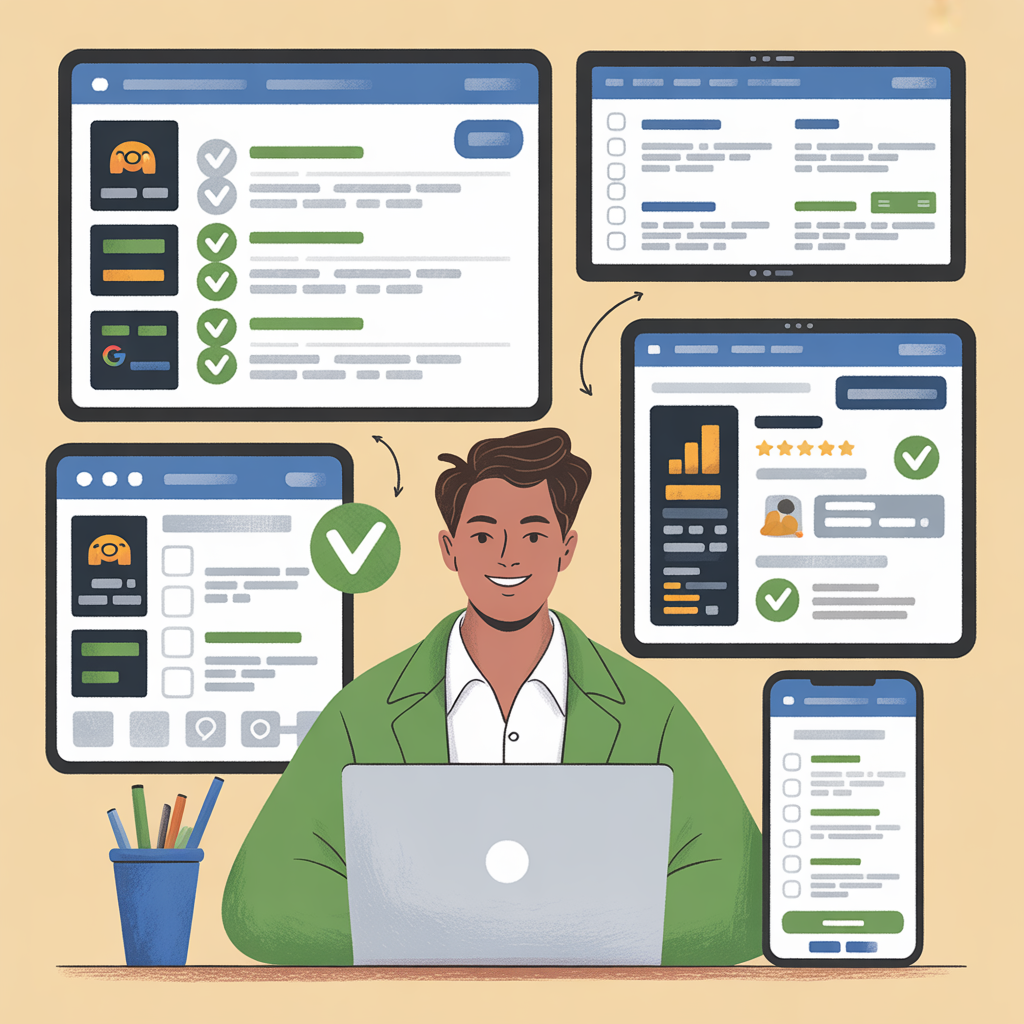
- Use multiple platforms simultaneously — Compare ratings across TripAdvisor, Google, Booking.com, and Expedia. If a hotel scores consistently across all four, that’s a stronger signal of authenticity.
- Look for “Verified Stay” badges — Booking.com and other platforms mark reviews from guests who actually booked through their site. These are significantly harder to fake.
- Prioritize reviews with guest photos — User-submitted photos are much harder to fake than text alone and give you a realistic look at the actual property.
- Pay attention to mid-range ratings (3–4 stars) — These tend to be the most balanced and informative reviews. Three-star reviewers usually explain exactly what worked and what didn’t.
- Visit travel forums — Reddit’s r/travel and r/solotravel, TripAdvisor’s discussion forums, and independent travel blogs often contain unfiltered, detailed accounts that you won’t find on booking platforms.
- Look for consistency over time — A hotel that maintains strong ratings over 3–5 years is much more trustworthy than one with a sudden surge of five-star reviews in the past month.
What to Do If You Suspect Fake Reviews
Found something suspicious? Don’t just scroll past it — take action. Here’s what you can do:
- Report to the platform: TripAdvisor, Google, and Booking.com all have reporting mechanisms for suspicious reviews. Look for a “flag” or “report” button near the review.
- Leave your own honest review: After your stay, write a detailed, balanced review that helps future travelers make informed decisions. Your honest voice matters.
- Contact the hotel directly: If you’re unsure about a specific claim in a review, reach out to the hotel’s front desk before booking. Their responsiveness and transparency will tell you a lot about how they operate.
- Share your findings: Post your observations on travel forums or social media. The travel community benefits when savvy travelers share what they’ve noticed.
Conclusion: Travel Smarter, Book with Confidence
Fake hotel reviews aren’t going away anytime soon — but that doesn’t mean you have to fall victim to them. By keeping an eye out for these 7 red flags, you’ll be in a much stronger position to make informed, confident booking decisions:
- Overly vague or generic language
- Extreme ratings with no middle ground
- Suspicious reviewer profiles
- Unnatural writing patterns and excessive superlatives
- Suspicious timing clusters of reviews
- Reviews that don’t match photos or reality
- Strange or scripted management response patterns
The more critically you read, the better traveler you become. Pair these red-flag checks with trusted tools like Fakespot, multi-platform comparison, and community forums — and you’ll be well-equipped to see through the noise and find accommodations that truly deliver on their promises.
At RoomNetic.com, we’re committed to helping you travel smarter. Explore our curated hotel recommendations and in-depth travel guides to plan your next trip with confidence — no guesswork, no nasty surprises.
Frequently Asked Questions About Fake Hotel Reviews
How common are fake hotel reviews?
Estimates vary, but research suggests that between 20% and 40% of reviews on major booking platforms may be fake or manipulated. The hospitality industry is among the most heavily affected sectors, given the direct financial impact of online ratings on bookings and revenue.
Can TripAdvisor detect fake reviews?
TripAdvisor uses a dedicated fraud detection team and automated systems to identify and remove suspicious reviews. However, no system is perfect. The platform estimates it catches the vast majority of fraudulent content, but sophisticated review farms can still slip through. Users are encouraged to report anything suspicious using the platform’s built-in flagging tools.
Is it illegal to post fake hotel reviews?
In many countries, yes. In the United States, the Federal Trade Commission (FTC) considers fake reviews a form of deceptive advertising and can impose significant fines. The European Union has also enacted laws under the Omnibus Directive targeting fake reviews. Businesses caught purchasing or posting fake reviews face legal consequences and reputational damage.
What percentage of online reviews are fake?
According to various studies, estimates range from 20% to 40% of online reviews being inauthentic across industries. A 2021 study by the World Economic Forum estimated that fake reviews influence approximately $152 billion in global consumer spending annually.
How do I know if a hotel review is real?
Look for specific details, verified stay badges, reviewer profile history, and consistency across multiple platforms. Authentic reviews typically include personal anecdotes, mention specific staff or amenities, and offer a balanced mix of positives and negatives. Tools like Fakespot can also help analyze review authenticity.
Do hotels pay for fake reviews?
Unfortunately, yes — some hotels do pay for fake reviews, either by hiring review farms, compensating guests with discounts or freebies in exchange for five-star ratings, or using third-party agencies. This practice violates the terms of service of all major review platforms and can result in penalties, including being blacklisted from the platform entirely.