

Picture this: you’ve just survived a grueling six-hour flight, your luggage is heavy, your feet are aching, and all you can think about is collapsing into that hotel bed you booked weeks ago. You step up to the front desk, hand over your confirmation number — and the receptionist gives you that uncomfortable look. “I’m so sorry, sir/ma’am, but we don’t have a room available for you tonight.” Your heart sinks. You have a confirmed reservation. You paid in advance. And yet, somehow, there’s no room at the inn. Welcome to the frustrating world of hotel overbooking. It happens more often than most travelers realize, and if you don’t know your rights, you could end up stranded, stressed, and out of pocket. This guide breaks down exactly what hotel overbooking is, why it happens, what you’re legally entitled to, and — most importantly — how to protect yourself before it ever becomes your problem.

What Is Hotel Overbooking?
Hotel overbooking occurs when a hotel accepts more reservations than it has available rooms. In other words, the hotel has sold more inventory than it can physically fulfill. If every guest who booked actually shows up on the same night, someone is going to be turned away at the door.
While this might sound like an obvious mistake, overbooking is actually a deliberate and widespread industry practice in hospitality — similar in concept to airline overbooking, but with some key differences. Airlines are required by law (particularly in the U.S. and EU) to follow strict compensation protocols when passengers are bumped. Hotels, by contrast, operate in a far less regulated environment, which means the experience of being displaced can vary wildly depending on the brand, the country, and how you booked.
Industry data suggests that hotel overbooking is surprisingly common, particularly during peak travel seasons, major events, and holidays. Some estimates indicate that major hotel chains overbook rooms at rates between 5% and 15% on high-demand nights, operating under the calculated assumption that a predictable percentage of guests will cancel or simply not show up.
Why Do Hotels Overbook?
Understanding the “why” behind overbooking helps take some of the sting out of the experience — though it certainly doesn’t make it any less inconvenient.
- Anticipated no-shows and cancellations: Hotels analyze historical data to predict how many guests will fail to arrive on any given night. Last-minute cancellations, especially from guests on flexible or free-cancellation rates, are factored into a revenue management formula that encourages overbooking as a hedge.
- Revenue management strategies: Hotels operate on thin margins and an empty room is lost revenue that can never be recovered. Overbooking is a calculated financial tool used by revenue managers to maximize occupancy and profitability.
- Third-party platform miscommunication: When bookings flow through multiple Online Travel Agencies (OTAs) like Booking.com, Expedia, or Hotels.com simultaneously, real-time inventory synchronization can lag or fail, resulting in the same room being sold twice.
- System errors and double bookings: Technical glitches in property management systems can create duplicate reservations that staff may not catch until check-in day.
What Actually Happens When You’re “Walked”
In hotel industry jargon, being displaced from your reserved room is called being “walked.” The term refers to the process of a hotel sending (or “walking”) an overbooked guest to another property nearby. It’s a polite euphemism for what is, in practice, a genuinely disruptive experience.
When a hotel realizes it is overbooked — usually during the afternoon check-in rush — the front desk manager begins identifying which guests will be relocated. This is rarely a random selection. Hotels typically consider several factors:
- Booking type: Guests booked through OTAs are often walked before guests who booked directly with the hotel.
- Loyalty program status: Elite or frequent-stay members are almost always protected from being walked, as upsetting loyal customers carries significant long-term cost.
- Rate paid: Guests on discounted or promotional rates may be bumped before those who paid full price.
- Arrival time: The last guest to check in on an overbooked night is frequently the one who gets walked.
- Length of stay: A guest staying one night may be walked before a guest who has a multi-night reservation.
The typical process involves the front desk manager offering you an alternative hotel of comparable or better quality, arranging transportation, and covering the cost of the first night. How smoothly this goes — and how generously the hotel responds — depends largely on the brand’s policies and the professionalism of the staff handling the situation.
Your Rights as a Guest When a Hotel Is Overbooked
General Guest Rights (Worldwide)
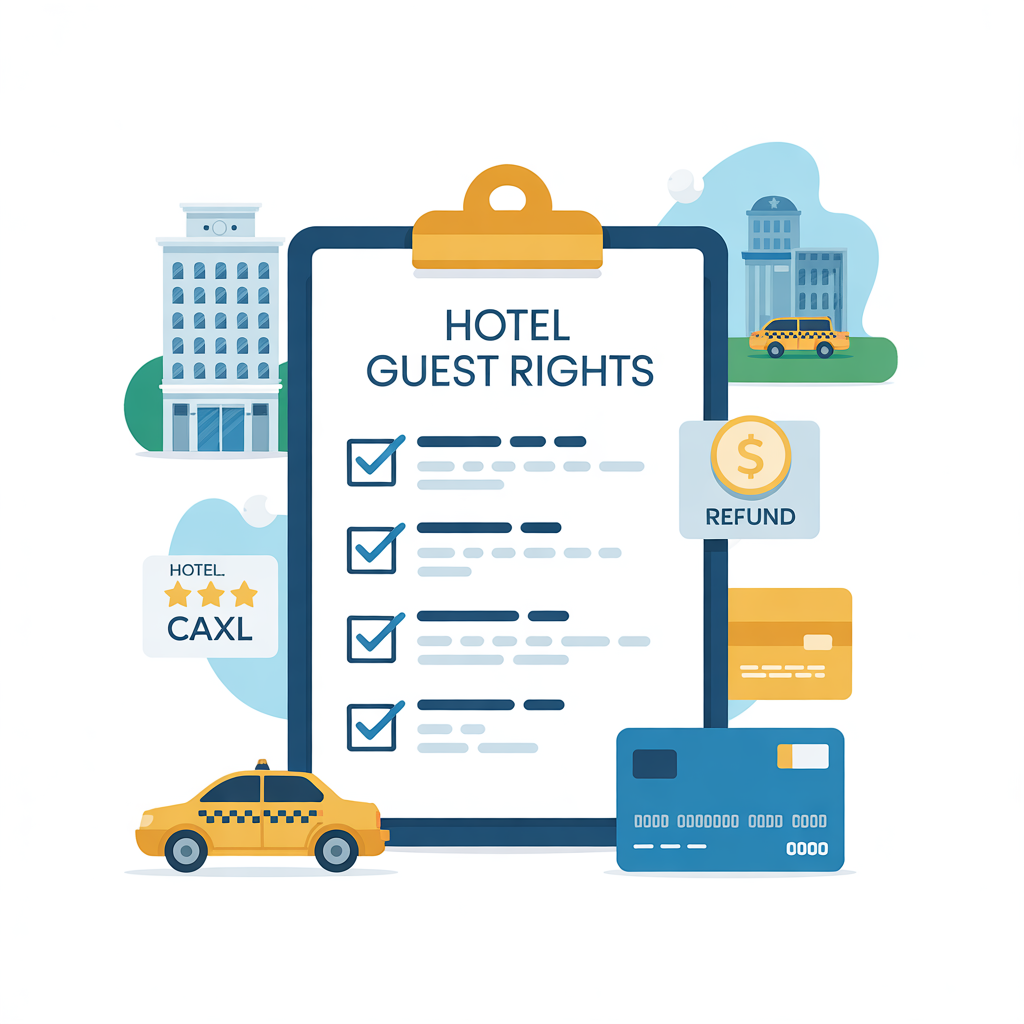
Regardless of where you are in the world, certain baseline rights apply when you’ve been displaced from a confirmed hotel reservation:
- Right to be informed promptly: You should be told about the situation as early as possible — ideally before you arrive, not after you’re standing at the counter with your luggage.
- Right to comparable or better accommodation: The hotel is obligated to find you a replacement room of equal or higher quality, in a reasonably convenient location.
- Right to transportation: The hotel should cover the cost of getting you to the replacement property, whether by taxi, rideshare, or shuttle.
- Right to a refund: If no suitable alternative is available, you are entitled to a full refund of any prepaid amount, including non-refundable rates in most jurisdictions.
Rights by Region
United States: There is no specific federal law governing hotel overbooking compensation. However, individual hotel brand policies, state consumer protection laws, and credit card chargeback rights can all work in your favor. Major brands like Marriott, Hilton, and Hyatt have explicit “walk” policies that guarantee comparable accommodation and transportation.
European Union: EU consumer protection regulations offer stronger safeguards. Package travel rules under Directive 2015/2302 require alternative arrangements and potential compensation if your trip is materially affected. General EU consumer rights also support claims for breach of contract when a confirmed reservation goes unfulfilled.
United Kingdom: Post-Brexit, the UK maintains its own Consumer Rights Act 2015 and package travel regulations, which afford guests similar protections to those in the EU. You have the right to services as described, and failing to deliver a booked room can constitute a breach of contract.
Other regions: Even where specific legislation is absent, the principle of contractual obligation applies globally. A confirmed booking is a legally binding agreement, and failure to honor it entitles the guest to remedy.
Rights Based on Booking Type
How you booked your room significantly affects your leverage when things go wrong:
- Direct bookings generally give you the strongest protection, as you have a direct contractual relationship with the hotel.
- OTA bookings (Booking.com, Expedia, etc.) can complicate matters, as the OTA acts as an intermediary. In many cases, the OTA will assist with rebooking, but responsibility can become blurred between the platform and the property.
- Credit card bookings with travel protection benefits (common with premium cards like Chase Sapphire, Amex Platinum) can offer an additional layer of financial recourse through chargebacks.
- Loyalty program members typically enjoy priority protection policies and may receive additional goodwill compensation such as points, upgrades, or complimentary future stays.
What Compensation Can You Expect?
Compensation for being walked varies by hotel brand, location, and how assertively you advocate for yourself. Here’s what you should reasonably expect and can actively request:
- Free accommodation at a hotel of equal or higher star rating for the night(s) affected
- Transportation costs covered in full, including return transportation the following morning if needed
- Meal vouchers or coverage for incidental expenses incurred due to the inconvenience
- Price difference refund if the replacement hotel costs less than what you originally paid
- Loyalty points or future stay credits as a goodwill gesture, particularly from major branded hotels
- Phone calls covered if you need to notify family, colleagues, or make new arrangements
If the hotel refuses to provide any compensation or stonewalls you at the front desk, escalate immediately. Ask to speak with the general manager, document everything in writing, and be prepared to pursue a credit card chargeback or file a complaint with your state or national consumer protection authority.
Step-by-Step: What To Do If Your Hotel Is Overbooked
When you find yourself being walked, how you respond in those first few minutes can make a significant difference in the outcome. Follow these steps:
- Stay calm and ask to speak with the manager. Emotional reactions rarely help. A composed, firm approach signals that you know your rights and expect them to be honored.
- Ask for written confirmation of the situation. Request documentation stating that the hotel is unable to fulfill your reservation. This is essential for any future claims.
- Get details on the alternative accommodation. Ask about the replacement hotel’s star rating, distance from your original destination, available amenities, and whether it meets your specific needs (e.g., accessible room, proximity to your meeting).
- Clarify who is paying for what. Confirm in writing that transportation, the room at the new hotel, and any price difference are covered by the original property.
- Document everything. Take photos of your original confirmation, write down the names of staff members you speak with, keep all receipts, and note the time and date of every interaction.
- Contact your OTA if you booked through one. Platforms like Booking.com and Expedia have customer service teams specifically trained to handle hotel overbooking disputes and can often negotiate on your behalf in real time.
- Dispute the charge with your credit card company if the hotel refuses reasonable compensation. Credit card chargebacks for services not rendered are a powerful tool and hotels are well aware of this.
- File a formal complaint if necessary. Leave a detailed review on TripAdvisor or Google, and consider reporting the incident to your country’s consumer protection authority if your rights were clearly violated.
How to Protect Yourself from Being Walked
The best way to handle hotel overbooking is to reduce your chances of it happening in the first place. These practical strategies significantly lower your risk:
- Book directly with the hotel whenever possible. Direct bookings are typically prioritized over OTA reservations when a hotel must decide who to walk.
- Join the hotel’s loyalty program. Even a basic membership can offer some protection. Elite status members are almost never walked at major chains.
- Confirm your reservation 24–48 hours before arrival. A quick call or email to the property puts you on their radar and flags your booking as active and committed.
- Arrive early in the day. Check-in windows are typically 2–4 PM, but arriving earlier — even if you only drop your bags — signals your presence and reduces the risk of being displaced.
- Use a credit card with travel protection. Premium travel cards often include accommodation dispute coverage and make the chargeback process straightforward if things go wrong.
- Keep all booking confirmations and receipts in a dedicated email folder or travel app so you can produce proof of reservation instantly if needed.
- Consider travel insurance that explicitly covers accommodation failures. Some policies include provisions for hotel overbooking that reimburse additional expenses incurred.

Real-Life Scenarios: Hotel Overbooking in Practice
Scenario 1 — Budget traveler during a peak event: A solo traveler books a budget hotel via Expedia during a major music festival weekend. She arrives at 9 PM (late, after a delayed train) to find the hotel fully occupied. Because she booked through an OTA and arrived last, she’s walked to a hotel two miles away. After calling Expedia’s customer service line, the OTA negotiates transportation and covers the difference in room cost. The inconvenience is real, but the outcome is manageable because she documented everything and acted quickly.
Scenario 2 — Business traveler with elite loyalty status: A Marriott Titanium Elite member arrives at a sold-out property the same night. Despite full occupancy, the front desk manager ensures his reservation is honored — even upgrading him to a suite to avoid displacement entirely. His status essentially acts as insurance. The lesson: loyalty programs are worth more than their points in situations like this.
Scenario 3 — Family vacation disrupted: A family of four on a pre-paid non-refundable rate arrives to find their room unavailable. The replacement hotel is a different brand, has no connecting rooms, and is 20 minutes away from their planned activities. After a tense negotiation, the hotel covers transportation and provides a partial refund for the inconvenience. The family’s key takeaway: always confirm reservations 48 hours in advance and use a travel credit card for bookings, as the card company ultimately helped recover additional costs.
Hotel Overbooking vs. Airline Overbooking: Key Differences
If you’ve ever been bumped from an oversold flight, you may have noticed that the airline handled the situation very differently from how a hotel typically does. That’s because the legal landscape is dramatically different.
In the United States, the Department of Transportation mandates specific compensation for involuntarily bumped airline passengers — up to 400% of the one-way fare (capped at $1,550) depending on the delay. In the EU, Regulation EC 261/2004 guarantees compensation between €250 and €600 for denied boarding. These are legally enforceable minimums that airlines must honor.
Hotels, by contrast, have no such equivalent federal or EU-level legislation specifically addressing overbooking compensation. What guests receive is largely determined by the hotel’s internal policies, brand standards, and the guest’s willingness to advocate for themselves. This regulatory gap means hotel guests are, in many cases, significantly less protected than airline passengers — making it all the more important to know your rights and document everything carefully.
Frequently Asked Questions About Hotel Overbooking
Can a hotel legally overbook?
Yes, in most countries there is no law explicitly prohibiting hotels from overbooking. It is considered a standard revenue management practice. However, the hotel is still legally bound by your confirmed reservation, and failure to honor it can constitute a breach of contract.
Is it the OTA’s fault if the hotel is overbooked?
Not typically. The responsibility for overbooking lies with the hotel, not the booking platform. That said, OTAs like Booking.com and Expedia do have responsibilities as intermediaries and are usually willing to assist guests in resolving the situation, including finding alternative accommodation.
What if the replacement hotel is far away or of lower quality?
You have the right to refuse an unsuitable alternative and demand either a better option or a full refund. If the replacement hotel is of lower quality, the original hotel should refund the difference in cost. Document the discrepancy thoroughly.
Can I sue a hotel for overbooking?
Technically, yes — a confirmed reservation is a contractual agreement, and failing to honor it can be grounds for a breach of contract claim. In practice, small claims court is the most realistic route for individual travelers seeking financial redress. Consult a local consumer rights attorney for guidance specific to your jurisdiction.
Does travel insurance cover hotel overbooking?
Some travel insurance policies include provisions for accommodation failures, which may cover additional expenses caused by hotel overbooking. Review your policy’s “trip interruption” or “travel inconvenience” clauses carefully, and consider selecting a policy that explicitly lists hotel overbooking as a covered event.
What if I prepaid a non-refundable rate?
Even if you booked a non-refundable rate, you are generally still entitled to a full refund if the hotel cannot provide the room you paid for. The non-refundable clause applies to voluntary cancellations by the guest — not to failures by the hotel to deliver the service.
Conclusion
Hotel overbooking is an uncomfortable reality of modern travel, but it doesn’t have to leave you helpless. The key takeaways are simple: know that overbooking is common and deliberate, understand that your confirmed reservation carries legal weight, and recognize that you have the right to comparable accommodation, transportation, and appropriate compensation when a hotel cannot honor its commitment to you.
More importantly, preparation is your most powerful tool. Book directly, join loyalty programs, confirm reservations in advance, arrive early, and keep meticulous records of every booking. The travelers who navigate overbooking situations most successfully are those who walk in informed, stay composed, and know exactly what to ask for.
Being walked is an inconvenience — but it’s one you can handle confidently when you know the rules of the game. Safe travels, and may your next check-in be smooth, swift, and exactly as expected.