

You’ve found the perfect hotel. The location is great, the reviews are glowing, and the price seems reasonable — until you hit the booking page and see a dozen room options staring back at you: Standard King, Deluxe Double, Superior Twin, Junior Suite, Executive Suite… Suddenly, what felt like a simple decision turns into an overwhelming puzzle. Sound familiar? You’re not alone. Millions of travelers book hotel rooms every day without fully understanding what these labels actually mean — and many end up disappointed, overpaying, or missing out on the comfort they deserved. This guide is here to change that. By the time you finish reading, you’ll know exactly what separates a Standard room from a Deluxe, what makes a Suite worth the splurge, and how to pick the right room type for any trip you take.
Why Hotel Room Categories Exist
Hotels aren’t just in the business of providing a bed to sleep in — they’re in the business of selling experiences at multiple price points. Room categories exist because travelers have wildly different needs, budgets, and expectations. A solo backpacker spending one night before a red-eye flight has very different requirements from a couple celebrating their anniversary or a CEO hosting client meetings from their hotel room.
By offering tiered room types, hotels can serve all of these guests simultaneously while maximizing revenue across their property. Each tier comes with its own set of amenities, size, location within the hotel, and price point — creating a structured ladder that guests can climb based on their budget and preferences.
Here’s something important to keep in mind: there is no universal industry standard for room naming. What one hotel brands as “Deluxe” might be called “Superior” at another. A “Suite” at a budget property may be smaller than a “Standard” room at a five-star resort. This inconsistency is one of the biggest sources of traveler confusion — and exactly why understanding the principles behind each category (rather than just the label) is so valuable.
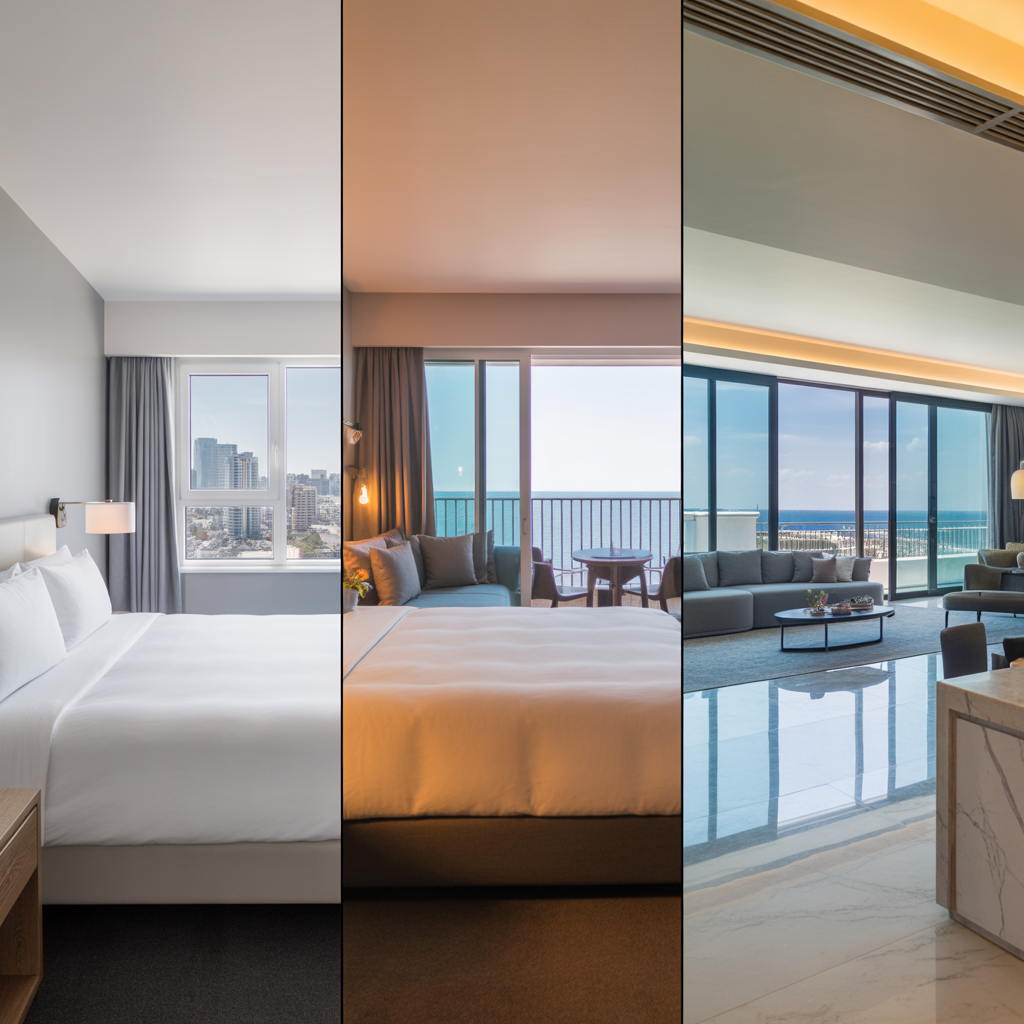
Standard Rooms: The Essentials
What Is a Standard Room?
A Standard room is the baseline offering of any hotel — the no-frills, functional option designed to give guests everything they need and nothing more. Think of it as the economy class of hotel accommodations: perfectly serviceable, but without the extra legroom.
Standard rooms typically range from 160 to 300 square feet (15 to 28 square meters), though this varies significantly by destination and property type. In major cities like New York or Tokyo, even a “standard” room can feel compact. In Southeast Asia or Eastern Europe, the same category might feel surprisingly spacious.
Furnishings in a Standard room usually include a bed (or beds), a work desk and chair, a wardrobe or closet, a TV, a telephone, and a private bathroom with basic toiletries. WiFi is now almost universally included, though the connection quality can vary.
Types of Standard Rooms
- Standard Single Room: One single or twin bed, designed for solo travelers. The smallest and most affordable option.
- Standard Double Room: Features one double bed, suitable for couples or solo travelers who want more sleeping space.
- Standard Twin Room: Two separate single beds, popular among friends traveling together or business travelers who need to share a room.
- Standard Queen Room: A queen-sized bed (approximately 60 x 80 inches), offering more space than a double while remaining cost-effective.
- Standard King Room: The largest bed configuration in the standard tier, featuring a king-sized bed (approximately 76 x 80 inches). Ideal for couples who prioritize sleeping comfort.
What to Expect in a Standard Room
Standard rooms almost always come with a private bathroom — shared bathrooms are now largely relegated to hostels and budget guesthouses. However, don’t expect a luxury bathing experience: you’ll typically find a shower/tub combo, a toilet, a sink, and a small vanity mirror.
Views from Standard rooms are the luck of the draw. You might get a pleasant city view or a depressing look at a concrete wall or a parking lot. Most hotels don’t guarantee any specific view at the Standard level, though you can always request a preference when booking.
In-room technology is fairly consistent: flat-screen TV, WiFi, air conditioning or heating, and sometimes a small kettle. What you won’t typically find in a Standard room: a minibar, a separate seating area, a bathtub, premium toiletries, or a view you’d want to photograph.
Who Should Book a Standard Room?
- Solo travelers and backpackers who treat their hotel as a place to sleep, not a destination in itself.
- Business travelers on tight expense budgets who just need a clean, comfortable space for one or two nights.
- Short-stay guests (one to two nights) who won’t spend much time in the room anyway.
- Budget-conscious families who would rather spend their money on experiences and activities.
Pros and Cons of Standard Rooms
| Pros | Cons |
|---|---|
| Most affordable option | Smaller space, less comfort |
| Widely available at all hotel types | Limited or no view guarantee |
| All essential amenities included | Basic décor and furnishings |
| Great for short stays | No extra seating or living space |
| Easy to upgrade from at check-in | May be in less desirable hotel locations |
Deluxe Rooms: The Upgrade Worth Considering
What Is a Deluxe Room?
A Deluxe room sits one rung above Standard on the hotel hierarchy — and that step up can make a meaningful difference to your stay. While the exact definition varies by property, Deluxe rooms generally offer more space, better views, enhanced furnishings, and upgraded amenities compared to their Standard counterparts.
Expect a size increase of roughly 30 to 60 square feet (3 to 6 square meters) over the Standard equivalent, though at luxury hotels, the gap can be much larger. The layout often feels more deliberate, with a proper seating area, better lighting, and higher-quality linens and furniture.
It’s worth noting that “Deluxe” is one of the most overused and inconsistently applied labels in the hotel industry. At a five-star property, Deluxe might mean a stunning ocean-view room with a rain shower and a private terrace. At a mid-range city hotel, it might simply mean you’re on a higher floor with a slightly nicer view. Always read the room description carefully rather than relying on the name alone.
Common Features of Deluxe Rooms
- Enhanced furnishings and more sophisticated interior décor
- Better or guaranteed views (higher floors, premium city/ocean/garden views)
- Upgraded bathroom amenities (separate bathtub and shower in many cases)
- Minibar or complimentary beverages
- A dedicated seating area with sofa or armchairs
- Premium bedding and pillows
- Larger work desk or writing area
Types of Deluxe Rooms
- Deluxe Double/King/Twin: The standard Deluxe room in its various bed configurations.
- Deluxe with Balcony: Adds an outdoor space — particularly popular at beach and resort properties.
- Deluxe Sea View / Garden View / City View: Guarantees a specific, desirable view, which is often the main selling point of the upgrade.
- Deluxe Corner Room: Located at the corner of the hotel building, these rooms often have two sets of windows offering panoramic views and more natural light.
Who Should Book a Deluxe Room?
- Couples on romantic getaways who want a memorable setting without committing to suite prices.
- Travelers celebrating special occasions (birthdays, anniversaries) who want that “something extra.”
- Frequent travelers who know the difference quality sleep environment makes to their energy levels and enjoyment.
- Anyone staying three or more nights at a destination where they’ll be spending meaningful time in the room.
Pros and Cons of Deluxe Rooms
| Pros | Cons |
|---|---|
| Noticeably better comfort than Standard | Costs 20–50% more than Standard |
| Better views and higher floor placement | Still no separate living area |
| Upgraded bathroom and amenities | “Deluxe” label can be inconsistent across brands |
| Sweet spot between budget and luxury | May not justify cost for very short stays |
Is the Price Difference Worth It? Standard vs. Deluxe
This is the question most travelers wrestle with. The honest answer is: it depends on your trip. If you’re spending most of your time exploring the city and only coming back to sleep, a Standard room is perfectly fine. But if you’re on a relaxing beach holiday, celebrating something special, or staying for a week or more, the upgrade to Deluxe is almost always worth it. The view alone — waking up to an ocean sunrise or a sparkling city skyline — can transform how you feel about your entire trip.
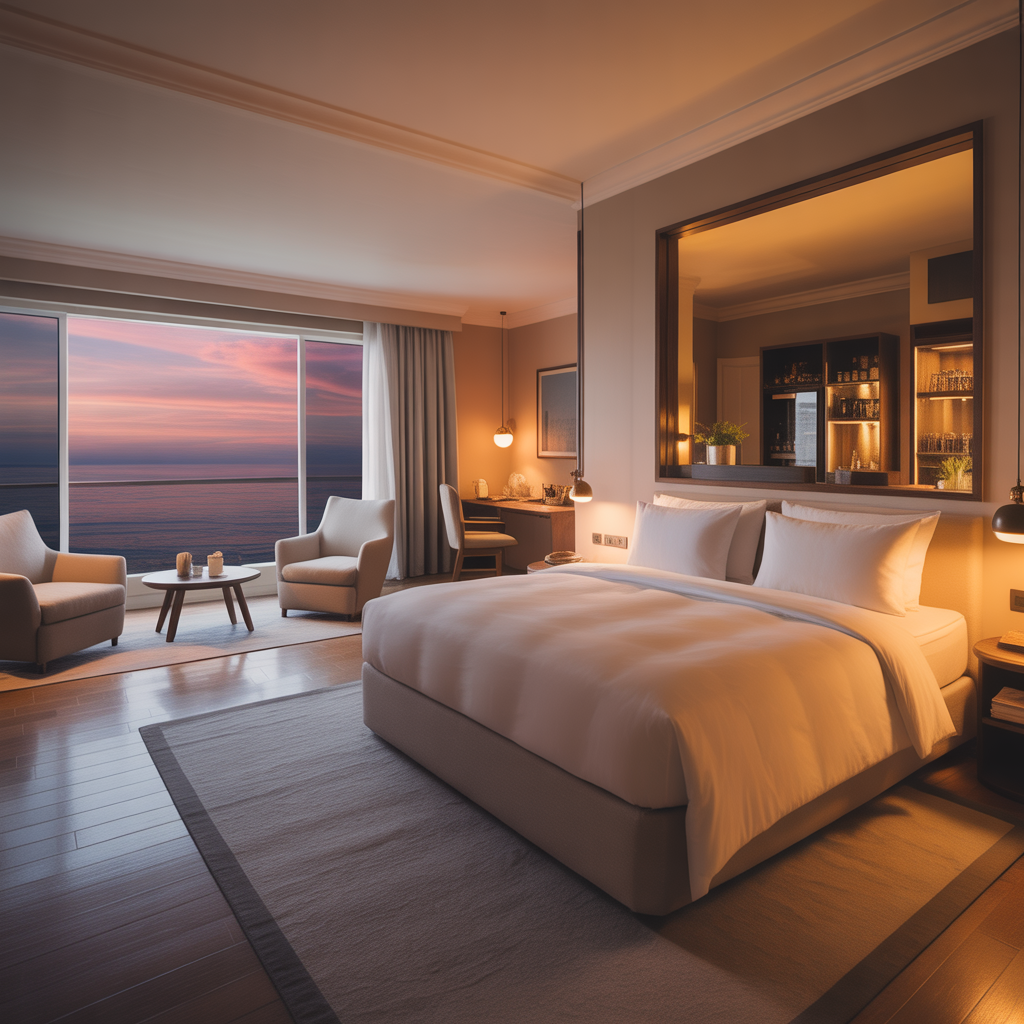
Suites: The Luxury Experience
What Is a Hotel Suite?
A Suite is the most premium category of hotel room and is defined by one key characteristic that sets it apart from everything else: a separate living area distinct from the sleeping area. While a Standard or Deluxe room combines your bed, seating, and workspace into one open space, a Suite gives you a proper living room — a room-within-a-room experience.
Suites are designed for guests who want more than a place to sleep. They want a full living experience — a space to entertain, work, relax, and indulge. Prices can range from a modest premium (around 50% more than a Standard room at mid-range hotels) to staggeringly expensive at ultra-luxury properties, where Presidential Suites can cost thousands of dollars per night.
Types of Hotel Suites
- Junior Suite: The entry point into suite territory. A Junior Suite typically features a partially divided or open-plan space where the sleeping and living areas are in the same room but functionally separated — often by a partition, a change in flooring, or furniture arrangement. These are the most affordable suite option and a great starting point for first-time suite guests.
- Classic/Standard Suite: This is the “true” suite — a full separate bedroom and a separate living room with a sofa, coffee table, and dining area. Bathrooms are usually significantly larger and more luxurious than anything found in a Standard or Deluxe room.
- Executive Suite: Tailored for business travelers, Executive Suites feature expanded workspace, high-speed connectivity, multiple phone lines, a proper dining table for meetings, and often access to the hotel’s exclusive Executive Lounge for complimentary breakfasts, evening cocktails, and concierge services.
- Penthouse Suite: Located on the top floor (or one of the top floors) of the hotel, Penthouse Suites offer panoramic views, expansive terraces, and the most premium finishes in the building. These are seriously special rooms.
- Presidential Suite: The pinnacle of hotel luxury. Often the largest and most opulent room in any property, the Presidential Suite may include multiple bedrooms, a full kitchen, a dining room, a private gym, a home theater, butler service, and a private terrace with a plunge pool. These rooms are as much an event as an accommodation.
- Family Suite: Designed with practicality in mind, Family Suites include extra bedrooms or sleeping alcoves, sometimes bunk beds for children, and layouts that give parents privacy while keeping the family together.
- Connecting Suites: Multiple suite rooms connected by interior doors, allowing larger parties or families to have private sleeping spaces while sharing common areas. Popular at resort destinations.
Key Features That Define a Suite
- A separate living room with full lounge furniture
- Dining area, sometimes with a formal dining table
- Kitchenette or full kitchen (in extended-stay and resort suites)
- Luxury bathroom with soaking tub, rain shower, double vanity, and premium toiletries
- Butler service or dedicated concierge in higher-tier suites
- Private terrace or balcony
- Access to Club Lounge or Executive Lounge
- Priority check-in and checkout, turndown service
Who Should Book a Suite?
- Honeymooners and couples celebrating once-in-a-lifetime occasions who want an unforgettable setting.
- Long-stay guests (one week or more) who need the space and comfort of a home-like environment.
- Business executives who need to host meetings, maintain a professional workspace, and impress clients.
- Large families who need extra bedrooms and shared living space without booking multiple rooms.
- Travelers celebrating milestone events — landmark birthdays, major anniversaries, graduation trips — where the experience is the point.
Pros and Cons of Suites
| Pros | Cons |
|---|---|
| Exceptional space and comfort | Significantly higher cost |
| Separate living area for work and relaxation | Can feel excessive for short stays |
| Premium bathrooms and amenities | Availability is limited at most properties |
| Exclusive services (butler, lounge access) | Price doesn’t always reflect quality (brand inconsistency) |
| Ideal for long stays and special occasions | Requires careful vetting — always check real photos |
Beyond the Big Three: Other Room Types to Know
The Standard-Deluxe-Suite framework covers the majority of hotel room decisions, but many properties offer additional categories that are worth understanding:
- Superior Room: Often positioned between Standard and Deluxe, a Superior room offers a modest improvement — slightly better décor, a higher floor, or a marginally better view — without the full Deluxe upgrade. Think of it as “Standard Plus.”
- Club Room: A Club Room is less about the room itself and more about what comes with it: access to the hotel’s exclusive Club Lounge. Club Lounges typically offer complimentary breakfast, all-day snacks and beverages, evening cocktails, and a dedicated concierge team. For frequent travelers, this can be exceptional value.
- Studio Room: Common in extended-stay and apartment-style hotels, Studio rooms feature an open-plan layout with a kitchenette integrated into the main living/sleeping space. Perfect for long stays where self-catering is desirable.
- Connecting/Adjoining Rooms: Two or more standard rooms with a lockable door between them. A practical solution for families who want proximity without sharing beds — parents get their room, children get theirs.
- Accessible Rooms: Designed to meet ADA or equivalent accessibility standards, these rooms feature wider doorways, roll-in showers, grab bars, lowered fixtures, and other features for guests with physical disabilities. Always book early as these rooms are limited.
- Villa / Bungalow / Cabana: Found primarily at resort properties, these are standalone or semi-detached private accommodations with their own outdoor space, plunge pool, or garden. They offer a level of privacy that no hotel room can match.
- Overwater Bungalow: The iconic luxury offering of destinations like the Maldives and Bora Bora — a private villa built over the water, often with a glass floor panel, direct ocean access, and unobstructed views. A bucket-list experience for many travelers.
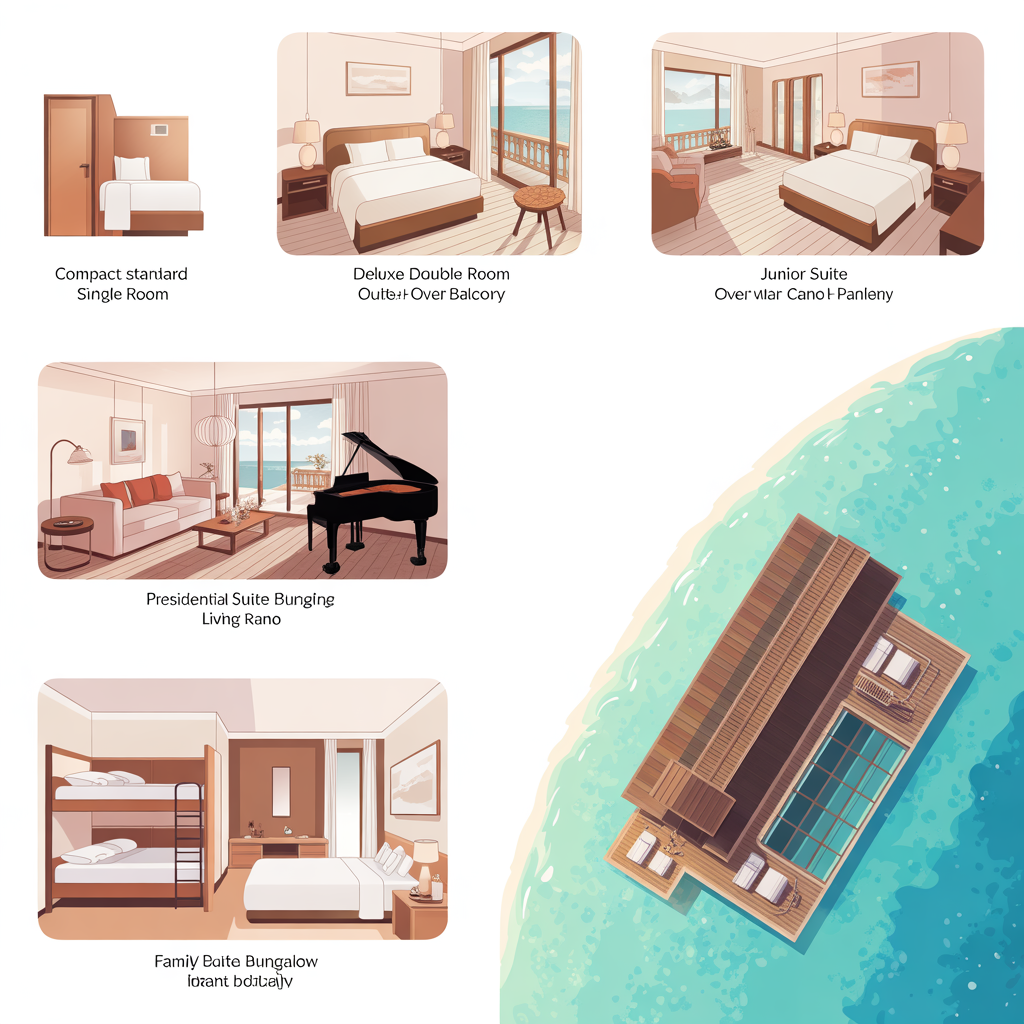
Standard vs. Deluxe vs. Suite: Side-by-Side Comparison
| Feature | Standard | Deluxe | Suite |
|---|---|---|---|
| Room Size | Small – Medium | Medium – Large | Large – Very Large |
| Separate Living Area | No | Rarely | Yes (defining feature) |
| View Quality | Basic / No guarantee | Enhanced / Often guaranteed | Premium / Panoramic |
| Bathroom Amenities | Basic | Upgraded | Luxury (soaking tub, rain shower) |
| Minibar / Kitchenette | Rarely | Often | Yes (kitchenette in many) |
| Butler / Concierge | No | No | Yes (in higher-tier suites) |
| Lounge Access | No | Sometimes | Often included |
| Price Range | $ | $$ | $$$–$$$$ |
| Best For | Budget / Short stays | Comfort upgrade / Couples | Luxury / Long stays / Special occasions |
How to Choose the Right Hotel Room Type for Your Trip
Consider Your Purpose of Travel
The single most important factor in choosing a room type is why you’re traveling. A solo business traveler who will spend 12 hours per day in meetings needs a clean, quiet room with a good desk and fast WiFi — a Standard room does the job perfectly. A couple on their honeymoon needs atmosphere, privacy, and a bathroom that feels like an experience — the investment in a Suite starts to make a lot of sense. A family of four on a two-week holiday needs space, practicality, and perhaps a kitchenette — a Family Suite or connecting rooms become the practical choice.
Evaluate Your Budget Honestly
Before you start browsing, set a clear accommodation budget and stick to it. Here’s a general principle: for short stays (one to two nights), save money on the room and spend it on experiences. For longer stays (four nights or more), investing in a better room pays dividends in comfort, rest, and overall trip enjoyment.
Smart ways to get upgrades without paying full price:
- Book directly with the hotel — many offer complimentary upgrades to direct bookers, especially during off-peak periods.
- Join the hotel’s loyalty program before your stay. Even as a new member, a polite request at check-in can yield a free upgrade.
- Travel during shoulder season. Hotels would rather give an unsold Deluxe room to a Standard guest than leave it empty.
- Celebrate something. Mention a special occasion (genuinely — hotels verify these) when booking, and you’d be surprised how often a complimentary upgrade or amenity appears.
Look Beyond the Room Name
This cannot be overstated: the room name tells you very little without the description to back it up. Always read the full room description before booking. Check the square footage — room size in square feet or square meters is one of the most reliable indicators of what you’re actually getting. Look at real guest photos on review platforms (not just the hotel’s marketing images). Read recent reviews that specifically mention the room type you’re considering.
Be particularly cautious with boutique hotels and smaller independent properties, where room naming can be entirely subjective and inconsistent with industry norms.
Timing and Booking Strategy
- Book direct when possible. Hotel websites often have price-match guarantees and bundle additional perks (breakfast, spa credits, late checkout) that third-party platforms don’t offer.
- Monitor pricing over time. Hotel room prices fluctuate based on demand. Prices often drop for mid-week stays and during shoulder seasons.
- Use loyalty programs strategically. If you travel regularly for business, concentrating your stays with one hotel group builds status quickly — and status comes with complimentary upgrades, early check-in, late checkout, and lounge access that can dramatically improve every stay.
Common Mistakes Travelers Make When Booking Hotel Rooms
- Assuming “Deluxe” always means better than “Standard.” Due to brand inconsistency, a Standard room at a luxury five-star property may actually offer more space and amenities than a Deluxe at a mid-range hotel. Always compare the actual specifications.
- Ignoring room location within the hotel. A Deluxe room on the second floor next to the elevator bank and ice machine can be a noisier, less pleasant experience than a Standard room on a high floor in a quiet corner. Always request a specific location when booking or at check-in.
- Overlooking included vs. excluded amenities. Some hotels charge separately for WiFi, breakfast, parking, and resort fees — items that would fundamentally change the value of your room booking. Read the fine print.
- Not checking the cancellation policy before upgrading. Suites and premium rooms often come with stricter cancellation terms. Make sure you understand the refund policy before committing to a higher-priced room.
- Booking based on price alone without checking room size. Two hotels might both offer a “Standard Double” at the same price, but one could be 180 sq ft and the other 280 sq ft. Size matters enormously for comfort, especially on longer stays.
Frequently Asked Questions
What’s the difference between a Junior Suite and a Suite?
A Junior Suite typically has the sleeping and living areas within the same room, though they may be functionally separated by furniture or layout. A full Suite features a completely separate bedroom and living room, usually divided by a wall and door. Junior Suites are a great entry point if you want more space than a Deluxe room but aren’t ready for the full Suite price.
Is a Deluxe room always better than a Standard room?
Not necessarily — it depends on the hotel. In most cases, a Deluxe room offers more space, better views, and enhanced amenities. However, due to inconsistent naming conventions across the industry, always read the room description and check real guest photos rather than relying on the label alone.
What does “Superior Room” mean?
A Superior Room is typically positioned between a Standard and a Deluxe room in a hotel’s hierarchy. It usually offers a modest improvement over Standard — perhaps a slightly larger room, a higher floor, or a better view — without the full Deluxe upgrade. It’s often a cost-effective middle ground.
Can I request a room upgrade at check-in?
Absolutely — and it works more often than you might think. The key is to be polite, flexible, and strategic. Arrive during off-peak check-in hours when the front desk is less busy, mention if you’re celebrating a special occasion, and ask graciously rather than demanding. Hotels with availability often accommodate upgrade requests, especially for loyalty program members.
How do I know if a suite is worth the extra cost?
Ask yourself these questions: Will I spend significant time in the room (long stay, working from the room, entertaining)? Is this a special occasion where the environment matters? Does the price difference represent good value relative to the extra space and amenities? If you answer yes to two or more of these, the suite is likely worth it.
What is a Club Room and is it worth it?
A Club Room typically refers to a standard or deluxe room that includes access to the hotel’s exclusive Club or Executive Lounge. These lounges offer complimentary breakfast, all-day light refreshments, evening cocktails and canapés, and often a dedicated concierge service. For frequent travelers or those on long stays, the lounge access alone can easily justify the price premium — especially when it replaces the cost of separate meals and drinks.
Conclusion
Choosing a hotel room doesn’t have to be a guessing game. Once you understand what Standard, Deluxe, and Suite categories actually mean — and how the many variations within each tier serve different traveler needs — you can approach every booking with confidence. The goal isn’t always to book the most expensive room; it’s to book the right room for your specific trip, budget, and priorities.
Match your room type to your purpose of travel. Invest in comfort when the stay is long or the occasion is special. Save strategically when all you need is a clean, comfortable place to rest. Use the tips in this guide to read beyond the marketing labels and make genuinely informed decisions. Your travel experience starts the moment you click “Book” — make sure that first choice sets the right tone for everything that follows.
Looking for more practical travel advice? Explore the full Travel section on RoomNetic.com for destination guides, hotel recommendations, packing tips, and everything else you need to travel smarter.