

Picture this: you booked a hotel room four months ago for a dream vacation, paid upfront to snag a great deal, and then — out of nowhere — your plans fall apart. A family emergency, a sudden work conflict, or a flight cancellation turns your excitement into anxiety. Now you’re left wondering: can I get my money back? The answer depends entirely on one thing most travelers overlook at booking time — the hotel cancellation policy. Understanding the difference between refundable and non-refundable hotel bookings isn’t just travel trivia; it can mean the difference between recovering your money and losing every dollar you paid. In this guide, we break down everything you need to know so you can book smarter, travel with confidence, and never get caught off guard again.

What Are Hotel Cancellation Policies?
A hotel cancellation policy is a set of rules established by a hotel (or a booking platform) that determines what happens financially when a guest cancels a reservation, changes their booking, or fails to show up for their stay. At its core, it defines whether you get your money back — and under what conditions.
Hotels put these policies in place for a very practical reason: revenue management. Every unsold room on a given night is lost income that can never be recovered. By setting cancellation rules, hotels can better forecast demand, manage their inventory, and minimize financial losses when guests cancel last-minute.
It’s also important to know who sets the cancellation policy. When you book directly with a hotel, the terms are set by the property itself. But when you book through third-party Online Travel Agencies (OTAs) like Booking.com, Expedia, or Hotels.com, the platform may layer its own policies on top of the hotel’s — sometimes making terms more or less flexible depending on the deal.
Before diving deeper, here are some key terms every traveler should understand:
- Cancellation deadline / cutoff date: The last date and time you can cancel without penalty.
- Cancellation fee: A charge applied if you cancel after the deadline — could be one night’s stay or the full amount.
- No-show policy: What happens if you simply don’t arrive without canceling — typically the harshest penalty.
- Early departure fee: A charge for checking out before your originally scheduled checkout date.
Refundable Hotel Bookings — Everything You Need to Know
What Does “Refundable” Mean?
A refundable hotel booking allows you to cancel your reservation within a specified time window and receive a full or partial refund of your payment. You’ll often see these listed under names like “Free Cancellation,” “Flexible Rate,” or “Pay Later” on booking platforms. The defining characteristic is flexibility — you’re not locked in, and your money isn’t at immediate risk.
How Refundable Policies Work
Most refundable bookings come with a cancellation window — a deadline before check-in by which you must cancel to receive your refund. Common windows include:
- 24 hours before check-in
- 48 hours before check-in
- 72 hours before check-in
- 7 days before check-in (common for luxury or resort properties)
In most cases, canceling within this window earns you a full refund. Canceling outside it (i.e., too late) may result in a partial refund or no refund at all, depending on the property’s terms. Refunds are typically processed within 5 to 10 business days, though credit card refunds can sometimes take up to two billing cycles.
Pros of Refundable Bookings
- Flexibility: Ideal if your travel plans are uncertain or subject to change.
- Peace of mind: Particularly valuable for bookings made months in advance.
- Business traveler-friendly: Corporate schedules shift constantly — flexible rates accommodate last-minute changes without financial penalty.
Cons of Refundable Bookings
- Higher rates: The flexibility comes at a cost. Refundable rates are typically priced higher than non-refundable alternatives.
- Deadline vigilance required: You still need to track and respect the cancellation cutoff date to avoid losing your refund.
Non-Refundable Hotel Bookings — Everything You Need to Know
What Does “Non-Refundable” Mean?
A non-refundable hotel booking is exactly what it sounds like: once you pay, that money is gone — regardless of when or why you cancel. These rates are commonly listed as “Advance Purchase,” “Non-Refundable Rate,” or “Pay Now” options. Payment is charged immediately at the time of booking, not at check-in.
How Non-Refundable Policies Work
With a non-refundable booking, your credit card is charged the moment the reservation is confirmed. There is no grace period, no partial refund window, and in most cases, no exceptions — even if you cancel weeks or months before your check-in date.
If you fail to show up (a “no-show”) on a non-refundable booking, the hotel retains the full payment. In some cases, the hotel may also charge an additional no-show fee on top of the booking amount.
Pros of Non-Refundable Bookings
- Lower rates: Non-refundable options are typically 10–25% cheaper than flexible rates for the same room.
- Best for confirmed plans: If your trip is set in stone — flights booked, events scheduled — a non-refundable rate is a smart way to save.
- Budget-friendly: Great for leisure travelers who prioritize savings over flexibility.
Cons of Non-Refundable Bookings
- High financial risk: Any unexpected change to your plans means losing the full amount paid.
- Zero flexibility: Even extenuating circumstances rarely lead to exceptions without extensive effort.
- Exceptions are rare: Obtaining a refund requires significant documentation and negotiation with limited guarantees.
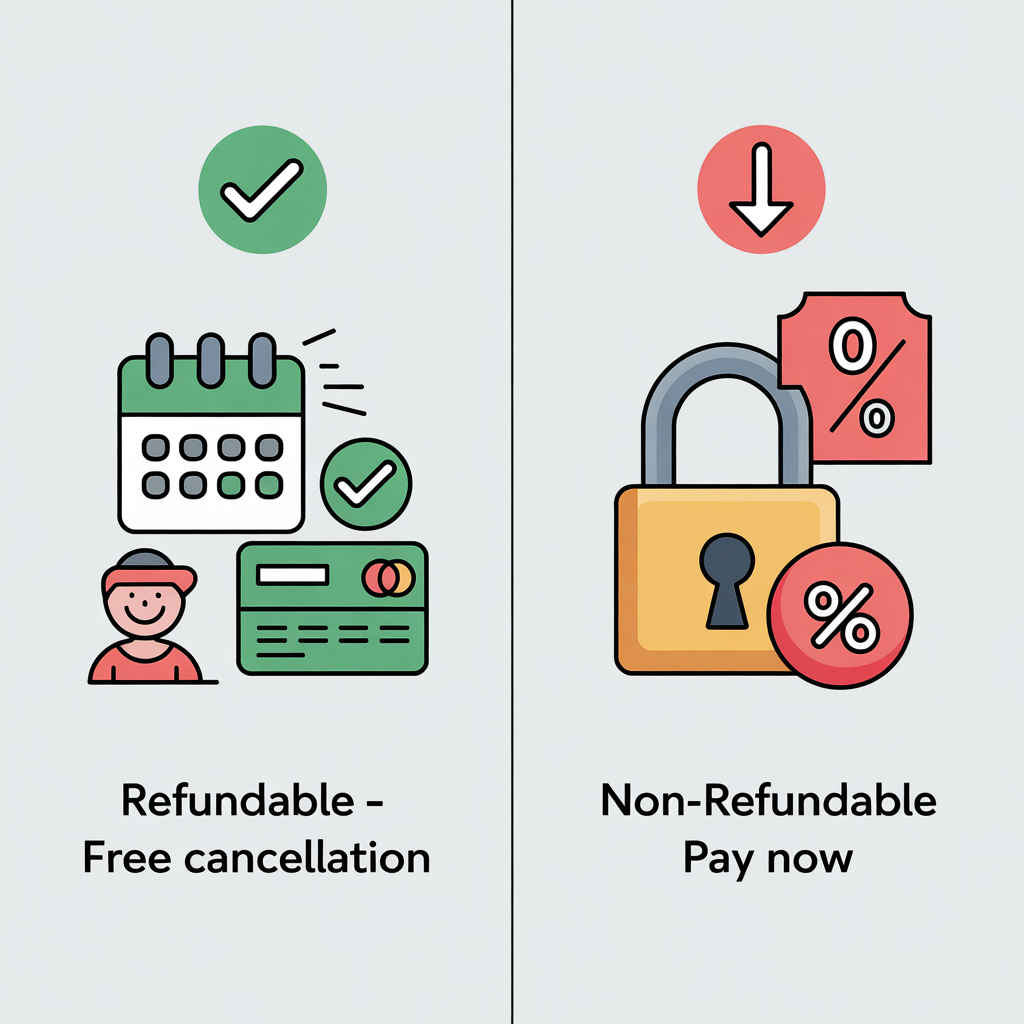
Refundable vs. Non-Refundable: Side-by-Side Comparison
Not sure which type of booking suits your situation? Here’s a quick comparison to help you decide at a glance:
| Factor | Refundable | Non-Refundable |
|---|---|---|
| Price | Higher | Lower (10–25% savings) |
| Flexibility | High | None |
| Payment timing | Usually at check-in | At booking |
| Risk level | Low | High |
| Best for | Uncertain plans | Fixed itineraries |
| Refund available | Yes (within deadline) | No |
Special Situations and Exceptions to Know
Force Majeure and Extraordinary Circumstances
Natural disasters, government-mandated travel bans, or global pandemics fall under what’s legally known as force majeure — events beyond anyone’s control. The COVID-19 pandemic set a powerful precedent: many hotels and booking platforms offered full refunds or free date changes for non-refundable bookings during lockdowns, something that would have been unheard of before.
However, these exceptions are not guaranteed and are entirely at the hotel’s discretion unless your booking explicitly includes emergency provisions. Always check if your destination is subject to travel advisories before assuming you’ll be covered.
Can You Get a Refund on a Non-Refundable Booking?
It’s rare — but not impossible. Here are a few avenues worth exploring:
- Contact the hotel directly: Call (don’t just email) the front desk or general manager. Explain your situation calmly and politely. Hotels value goodwill and may offer a date change or credit rather than a cash refund.
- Travel insurance: If you purchased a policy that covers trip cancellations, you may be able to file a claim and recover non-refundable costs. More on this below.
- Credit card chargeback: In cases where a hotel fails to deliver what was promised (e.g., the room was significantly different from what was advertised), you may have grounds for a chargeback through your credit card provider.
- Booking platform escalation: If you booked through an OTA, their customer service team may be able to negotiate on your behalf — especially if you have documented extenuating circumstances.
Loyalty Program Members and Elite Status Benefits
If you’re a member of a hotel loyalty program — such as Marriott Bonvoy, Hilton Honors, or IHG One Rewards — your elite status may come with enhanced cancellation benefits. Higher-tier members often receive more flexible cancellation windows, waived fees, or the ability to rebook at the same rate. If you travel frequently, joining a hotel loyalty program is one of the smartest moves you can make for long-term flexibility and savings.
The Role of Travel Insurance
Travel insurance is one of the most underutilized tools in a traveler’s toolkit — and it becomes critically important when non-refundable hotel bookings are involved.
A standard trip cancellation insurance policy typically covers non-refundable costs if your trip is canceled due to covered reasons: illness, injury, death of a family member, severe weather, or jury duty. However, it won’t cover every scenario — hence the rise of Cancel for Any Reason (CFAR) policies.
CFAR policies allow you to cancel for literally any reason and recover up to 50–75% of your prepaid, non-refundable trip costs. They are typically purchased within 14–21 days of your initial trip deposit and cost about 40–60% more than standard policies — but for expensive, non-refundable trips, the peace of mind is often worth it.
When is travel insurance worth the cost? Consider purchasing it when:
- Your total non-refundable trip costs exceed $500
- You’re booking an international trip far in advance
- You have health conditions that could affect travel
- You’re traveling during hurricane season or to a politically unstable region
Cancellation Policies on Third-Party Booking Platforms
One of the most confusing aspects of hotel cancellation policies is how they can vary depending on where you book. The same hotel room may show different cancellation terms on the hotel’s official website, Booking.com, Expedia, and Hotels.com — all at the same time.
This happens because OTAs negotiate their own rate agreements with hotels, and those agreements sometimes include platform-specific terms. A “free cancellation” label on a third-party site may have stricter or looser deadlines than booking directly.
Tips for reading the fine print on booking platforms:
- Always click on the full cancellation policy details — don’t just rely on “Free Cancellation” labels.
- Note the exact cancellation deadline time zone (a hotel in Paris listing “cancel by midnight” may mean Paris time, not your local time).
- Understand that refunds on third-party bookings may take longer to process, as the platform acts as a middleman.
The direct booking advantage: Booking directly with a hotel almost always gives you better flexibility, easier modifications, and faster resolution in case of disputes. Hotels are also more inclined to make exceptions or offer goodwill gestures for guests who booked directly.

Practical Tips for Travelers
- Always read the cancellation policy before confirming. It takes 30 seconds and can save you hundreds of dollars.
- Screenshot or save your booking confirmation and cancellation terms. Policy details can sometimes change after booking — having a record protects you.
- Set a calendar reminder for the cancellation deadline. A simple phone reminder 24 hours before the cutoff could save your refund.
- Consider your trip certainty level. If there’s any doubt about your plans, pay the premium for a flexible rate.
- Compare the price difference honestly. If a non-refundable rate saves you $30 on a $400 booking, ask yourself: is that 7.5% savings worth the risk of losing $400?
- Book directly with the hotel when possible. You’ll get better flexibility, loyalty points, and easier issue resolution.
- Use travel insurance for non-refundable bookings on expensive trips. Especially for international travel or high-cost accommodations.
Frequently Asked Questions (FAQ)
What is the typical hotel cancellation policy?
Most hotels offer a standard free cancellation window of 24 to 48 hours before check-in for flexible rates. Luxury resorts and boutique properties may require 7 days or more. Non-refundable rates have no cancellation window — payment is final at booking.
How long does a hotel refund take?
Hotel refunds typically take 5 to 10 business days to process, though it can take up to two billing cycles depending on your credit card provider. Debit card refunds may take slightly longer. If you booked through an OTA, add extra processing time for the platform’s internal procedures.
Can I get a refund on a non-refundable hotel booking?
It’s difficult but not impossible. Your best options are: contacting the hotel directly to explain your circumstances, filing a travel insurance claim, or — in rare cases involving hotel error — initiating a credit card chargeback. There are no guarantees, but a polite, direct approach with documentation often yields the best results.
What happens if I don’t show up to a non-refundable hotel booking?
If you no-show on a non-refundable booking, the hotel will charge your card the full amount (if not already charged) and you will not receive any refund. Some hotels may also add an additional no-show fee. Your booking is effectively forfeited.
Is it better to book refundable or non-refundable hotels?
It depends on your situation. If your plans are firmly set and you’re confident nothing will change, a non-refundable rate offers real savings. But if there’s any uncertainty — especially for bookings made months in advance — a refundable rate is the smarter, lower-risk choice.
Does travel insurance cover non-refundable hotel bookings?
Yes, in most cases. Standard trip cancellation insurance covers non-refundable hotel costs if you cancel for a covered reason (illness, death of a family member, severe weather, etc.). For broader protection, a “Cancel for Any Reason” (CFAR) add-on lets you cancel for virtually any reason and recover 50–75% of prepaid costs.
Conclusion
Hotel cancellation policies may feel like small print that’s easy to skip — but they carry real financial consequences every traveler should understand. To recap: refundable bookings offer flexibility and peace of mind at a slightly higher price, while non-refundable bookings deliver meaningful savings in exchange for zero flexibility. Neither is universally better — the right choice depends on your trip certainty, budget, and tolerance for risk.
The golden rule? Make your booking decision before you confirm, not after. Assess how confident you are in your plans, compare the rate difference honestly, and when in doubt, always opt for the flexible rate or protect your investment with travel insurance.
Ready to find the perfect hotel with clear, transparent cancellation policies? Explore thousands of properties on RoomNetic.com, where you can filter by cancellation policy, compare rates side by side, and book with complete confidence — whether your plans are set in stone or still taking shape.